
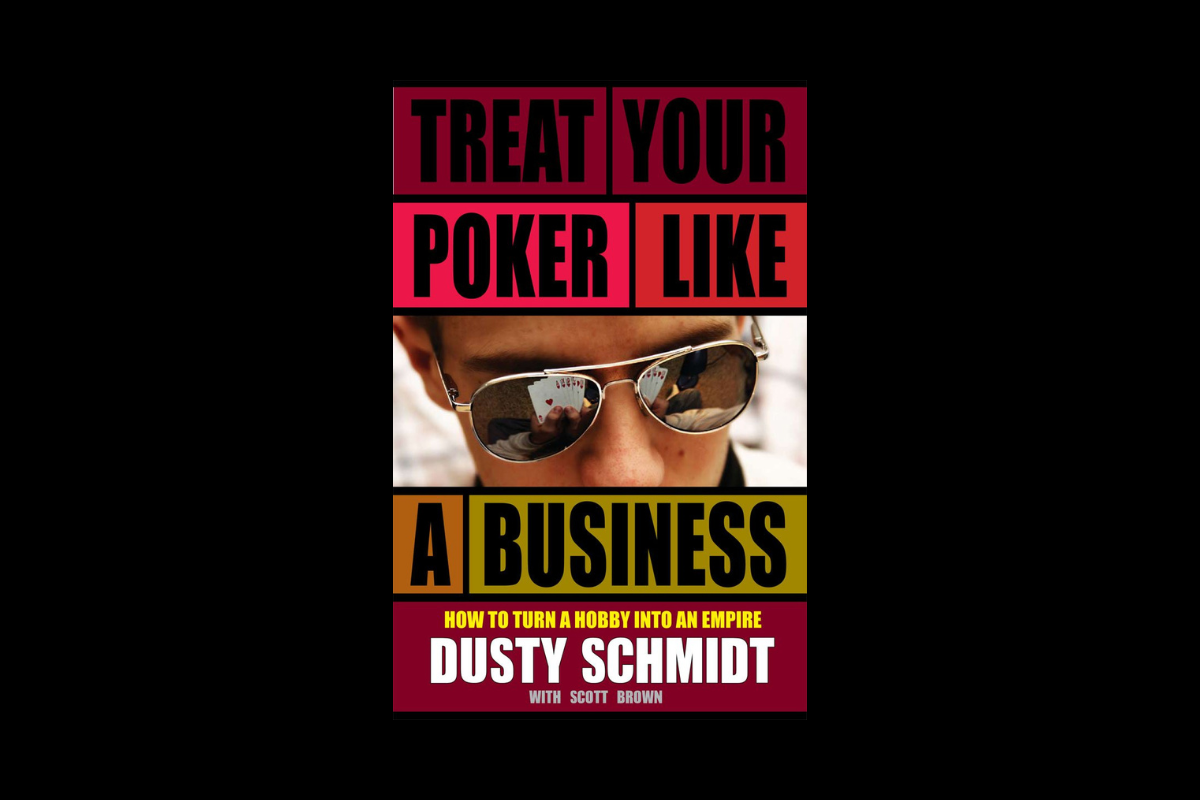
Here are chapters 41-43 of our Treat Your Poker Like A Business summary:
Chapter 41: Telling Them What You Do for a Living
In chapter 41 of Treat Your Poker Like A Business, Dusty Schmidt discusses the social perception of being a professional poker player.
Confronting Social Judgment
Despite poker’s increasing mainstream visibility, many people still equate professional poker with gambling irresponsibility. Schmidt recounts how uncomfortable he once felt explaining his profession.
He emphasizes that insecurity invites criticism. If you present your career defensively, others will treat it skeptically.
Confidence and Ownership
Schmidt advises:
-
Speak about your profession confidently
-
Avoid apologetic explanations
-
Understand that independence commands respect
He closes the chapter with a guiding idea: a person gives dignity to the profession—not the other way around.
Chapter 42: Strategy: Ten Common Situations and How to Play Them
In chapter 42 of Treat Your Poker Like A Business, Schmidt presents a structured breakdown of 10 common no-limit hold’em situations:
1. Playing Drawing Hands In Position
Here are Dusty’s recommendations for playing drawing hands in position:
-
With nut draws, he prefers playing fast early (often raising the flop) to win immediately or build a pot where you still have strong equity if money goes in.
-
With non-nut draws, he mixes in more calls and selective aggression, looking to take the pot on later streets when opponents show weakness—while also staying unpredictable against regulars.
2. Playing Drawing Hands Out Of Position
When out of position, Dusty recommends playing your drawing hands this way:
-
With nut draws, he still favors fast, aggressive lines (leading or check-raising) because strong equity allows confident semi-bluffs and gives ways to win without hitting.
-
With non-nut draws, he offers both “fight” lines (including shove equity) and “small-ball” lines (call, then attack weakness on later streets), while acknowledging you’re less likely to stack worse draws.
3. Playing Small Pocket Pairs Without Set-Mining Dependence
Schmidt argues small pairs become losing if you only “hope to flop a set” and surrender otherwise—especially vs thinking players.
-
He recommends using small pairs as structured bluff candidates (flop raises/check-raises) to balance ranges and punish opponents who assume your aggression is always value.
-
Bonus upside: sometimes you spike a set later or win at showdown when opponents are floating with air.
4. Handling Aggressive Pre-Flop 3-Bettors
He keeps it straightforward:
-
Fight back with frequent 4-bets (sized to apply pressure without overcommitting).
-
Call some 3-bets and raise flops to force opponents to prove they have real strength.
-
Occasionally trap with premiums against players who auto-fire post-flop.
-
Be willing to leave if the table doesn’t contain enough weak money to justify the stress and attention drain.
5. Keeping Pots Small Pre-Flop Against Tough Opponents
Against strong players, Schmidt sometimes prefers smaller open sizes to:
-
Reduce variance and emotional strain
-
Keep opponents less “invested” and therefore less sharp post-flop
-
Take cheap shots at stealing blinds
He stresses not to reduce pot size at the expense of clear edges—especially vs weak players, where he prefers building bigger pots.
6. Utilizing Position Post-Flop: Five High-Leverage Habits
He highlights position as a main profit engine, especially when multi-tabling:
-
Don’t auto-fold to c-bets when you miss; position gives turn opportunities and card equity.
-
Re-raise loose aggressors pre-flop to stop them from controlling the table.
-
Run more multi-street bluffs vs opponents who call flop/turn but hate river pressure.
-
Value bet thinner on the river because many players get timid when pots are biggest.
-
Use small turn raises after checking flop back to control the river, gain information, deny equity, and sometimes fold out better hands.
7. Identifying Board Textures That Make Good Bluff Targets
He recommends selectively attacking boards that tend to miss common ranges or create fear:
-
Ace-high boards (especially if you can pressure multiple streets)
-
One high card + two low cards (good for raises)
-
Paired boards (less likely opponents connect strongly)
-
Certain draw-heavy boards (particularly in position) where a raise credibly represents strength
Key limiter: don’t overdo it—frequency control prevents becoming exploitable.
8. When to Continuation Bet vs. When to “Punt”
Schmidt’s blunt rule: don’t c-bet boards that smash your opponent’s calling range when you have little equity or playability, especially out of position.
He prefers c-betting when at least one is true:
-
The flop is dry and unlikely to connect
-
You have meaningful outs to a hand you can value confidently
-
The board structure lends credibility (often including ace-high textures)
9. Bluff Philosophy Across Streets
His practical heuristic:
-
Earlier streets = more bluffs and more noise
-
Later streets = more honest strength
He treats river bluffs as rarer and more situational, because the cost is high and most solid players don’t bluff as a default at that stage.
10. Playing From Early Position: Defense First
Early position is framed as danger territory:
-
You’re usually out of position if called
-
Strong players in blinds/behind won’t give action without strength
-
You should tighten up unless the table is soft (especially with weak players behind/blinds)
He also advises:
-
Respect re-raises from tight opponents and avoid stubbornly continuing with hands that become hard to profitably navigate out of position.
-
Don’t get attached to small pairs early unless conditions are great.
-
If you do run big bluffs, early-position opens can make multi-street pressure more credible because your range is perceived stronger.
Overall, the chapter blends mathematics, fold equity, range construction, and psychological pressure into practical frameworks.
Chapter 43: Strategy — Five Effective Plays That Are Underutilized
In chapter 43, Schmidt introduces five advanced but selectively used tactics.
1) “Checking With a Chip” (Tiny River Block/Info Bet)
This is a river tactic for when:
-
you suspect you have a medium-strength hand,
-
you don’t want to face a large bet after checking,
-
and a normal value bet may be too thin.
How it works
-
You bet the minimum (or near-minimum) on the river.
-
If called by better, you lose very little.
-
If called by worse, you pick up extra value you might not get if you checked.
-
If raised, Schmidt argues that—against most opponents—this polarizes heavily toward bluffs, letting you call more confidently than you could after a check.
Purpose
-
Cheap showdown access, cheap information, and sometimes a trap for players who can’t resist “punishing” the tiny bet.
2) Weak Leading to Induce a Raise (Small Bet When Big Bet Won’t Get Called)
This is for spots where you’re ahead, but:
-
your opponent’s range is marginal and likely to fold to normal sizing,
-
checking won’t reliably induce a bluff,
-
and you want to create action.
How it works
-
After a turn card that “kills action” (often an overcard), you make a deliberately small value bet.
-
It can bait aggressive opponents into raising, or confuse opponents into calling wider because the price is tempting.
-
Schmidt also likes it because the same small sizing can be used as a bluff sometimes, keeping your line balanced.
Purpose
-
Extract value from hands that otherwise escape, while occasionally generating spew raises from opponents who interpret weakness.
3) “The Killer Blow” (Turn Check-Raise, Then River Jam)
This is a two-street pressure line built around a capped opponent range:
-
Opponent checks back flop → often signals weakness or a marginal hand.
-
You then give them rope to bet turn.
-
You check-raise turn big enough to suggest stacks are in play.
-
If they call, Schmidt expects many opponents to reach the river with a range that struggles to withstand a shove.
Key conditions
-
Best on relatively dry boards where missed draws aren’t abundant.
-
Works best against opponents who dislike facing for-stacks decisions with bluff-catchers.
-
Requires discipline not to spam it, and awareness of opponents who love hero calls.
Purpose
-
Build a believable story across turn+river that forces folds from hands that might otherwise “look you up” once.
4) The Delayed Continuation Bet (Skip Flop, Attack Turn)
This targets opponents who:
-
routinely check-raise flops,
-
and force you into unpleasant decisions with weak-to-medium hands.
How it works
-
As the preflop raiser, you check back the flop to dodge the check-raise trap.
-
When they stab the turn, you raise and put the burden on them to continue without having shown real strength.
Why it’s effective
-
It flips initiative: instead of you betting and getting attacked, you let them bet first, then you attack.
-
It can also protect you from lighting money on fire with low-EV flop c-bets on boards that interact well with their calling range.
Purpose
-
Neutralize habitual flop aggression and reclaim leverage on a later street.
5) Shoving When They “Can’t Have It” (Re-Steal vs Incoherent Flop 3-Bets)
This is the most explosive play, and Schmidt is clear it depends on board texture:
-
it requires an extremely dry flop with minimal drawing potential.
The logic
-
You check-raise a dry flop as a bluff.
-
If your opponent re-raises the flop (instead of calling), Schmidt argues that line is often inconsistent with strong value hands, because strong hands frequently prefer to keep your bluffs alive.
-
That inconsistency creates a window to shove over the top, leveraging maximum fold equity.
Warnings
-
If the board is draw-heavy, opponents can re-raise semi-bluffs and continue more often, making the shove far worse.
-
Don’t run it into opponents who take aggressive value lines on dry boards.
Purpose
-
Punish “re-steal” aggression by applying a final layer of pressure when their range is likely capped.
Practical Takeaways
-
These plays aren’t meant to replace solid fundamentals; they’re specialized tools for spots where typical lines either lose value or create difficult guessing games.
-
Each move is strongest when it exploits a common population tendency: overreacting to weakness, over-bluffing early streets, or failing to follow through under river pressure.
-
Schmidt’s recurring caution: use them selectively, or opponents will adjust and the edge disappears.