
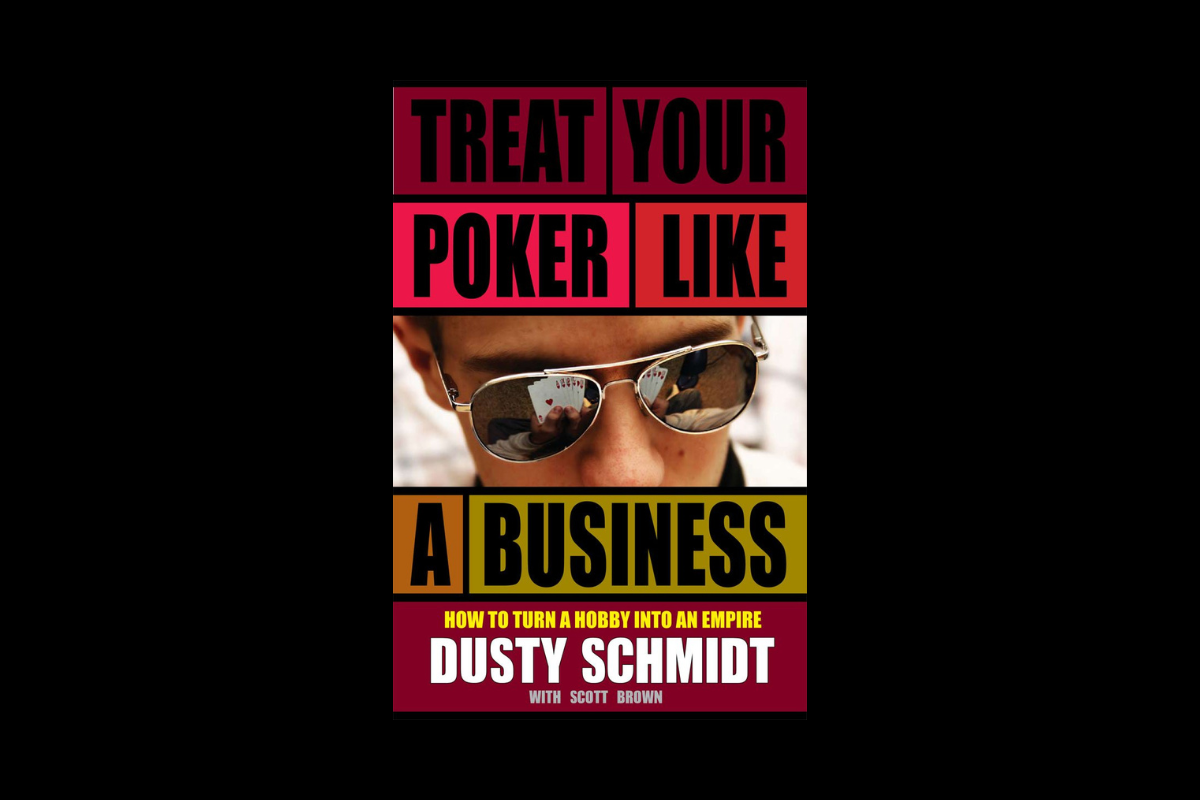
Here are chapters 1-5 of our Treat Your Poker Like A Business summary:
Chapter 1: Treating Poker as a Business
In chapter 1 of Treat Your Poker Like A Business, Dusty Schmidt introduces the central thesis of the book: poker should be approached as a structured business rather than as gambling, entertainment, or a pursuit of ego.
Poker as an Enterprise
Schmidt emphasizes that successful professionals separate emotion from execution. Instead of chasing excitement, they focus on:
-
Maximizing expected value
-
Minimizing risk
-
Protecting capital
-
Building long-term profitability
He draws parallels between poker and traditional small businesses. Just as a restaurant must manage costs, inventory, and customer flow, a poker player must manage bankroll, table selection, and time allocation.
Skill vs. Profit
One of the first distinctions he makes is between being good at poker and making money from poker. Many skilled players fail financially because they:
-
Play too high too fast
-
Ignore bankroll discipline
-
Tilt away profits
-
Focus on image instead of income
The professional mindset requires discipline, humility, and long-term thinking.
Chapter 2: Bankroll Management
In chapter 2 of Treat Your Poker Like A Business, Dusty Schmidt explains that bankroll management is the foundation of a profitable poker career.
The Bankroll as Working Capital
Your bankroll is not disposable income—it is business inventory. If it disappears, your business shuts down.
Schmidt advocates extremely conservative guidelines, recommending:
-
Around 100 buy-ins for cash games before moving up in stakes
-
Moving down quickly when necessary
-
Never playing emotionally driven “shot-taking” sessions
Reducing Risk of Ruin
Even highly skilled players can go broke if undercapitalized. Variance is inevitable, and without proper reserves, downswings can wipe out months of work.
He frames conservative bankroll management not as fear-based, but as strategically aggressive—because it ensures survival long enough for skill to compound.
Chapter 3: Understanding Variance
In chapter 3 of Treat Your Poker Like A Business, Dusty Schmidt addresses variance and its psychological and financial implications.
Variance Is Not Personal
Poker includes short-term randomness. Good players lose. Bad players win temporarily. This is built into the structure of the game.
Schmidt stresses that misunderstanding variance leads to:
-
Tilt
-
Overconfidence during heaters
-
Despair during downswings
-
Poor decision-making
Emotional Stability
The key is to detach emotionally from short-term results and focus on decision quality. If you consistently make +EV decisions, long-term profitability follows.
Making peace with variance is not optional—it is mandatory for sustained success.
Chapter 4: Tilt Control
In chapter 4 of Treat Your Poker Like A Business, Dusty Schmidt argues that tilt is one of the biggest profit killers in poker.
Tilt as a Leak
Tilt is not just emotional frustration—it is a breakdown in discipline that results in negative expectation decisions.
He explains that tilt often stems from:
-
Entitlement (believing you “deserve” to win)
-
Ego conflicts
-
Misunderstanding variance
-
Fatigue
Prevention Over Recovery
Rather than focusing only on recovering from tilt, Schmidt emphasizes building systems to prevent it:
-
Playing within bankroll
-
Keeping sessions structured
-
Avoiding ego battles
-
Taking breaks when emotional stability declines
The disciplined professional limits exposure to emotional volatility.
Chapter 5: Table Selection
In chapter 5 of Treat Your Poker Like A Business, Dusty Schmidt highlights table selection as one of the most overlooked edges in poker.
Choosing Your Customers
In business, location matters. In poker, your location is the table you choose.
Schmidt encourages players to:
-
Actively seek weaker opponents
-
Avoid unnecessary battles with strong regulars
-
Leave games when conditions deteriorate
He views weak players as customers and strong professionals as competitors. Smart business owners prioritize revenue opportunities over ego-driven competition.
Ego vs. Profit
Many players stay in tough games to prove something. Schmidt rejects this mentality. The goal is not to win respect—it is to maximize hourly income.
He frames leaving a bad table not as weakness, but as strategic decision-making.
Combined Core Message (Chapters 1-5)
Across the first five chapters, Schmidt builds a foundation:
-
Treat poker as a structured business
-
Protect your capital aggressively
-
Accept variance as part of the system
-
Eliminate emotional leaks
-
Choose profitable environments deliberately
The early chapters establish that long-term poker success is not about brilliance at the table alone. It is about discipline, risk management, and consistent execution—the same principles that govern successful businesses in any industry.