
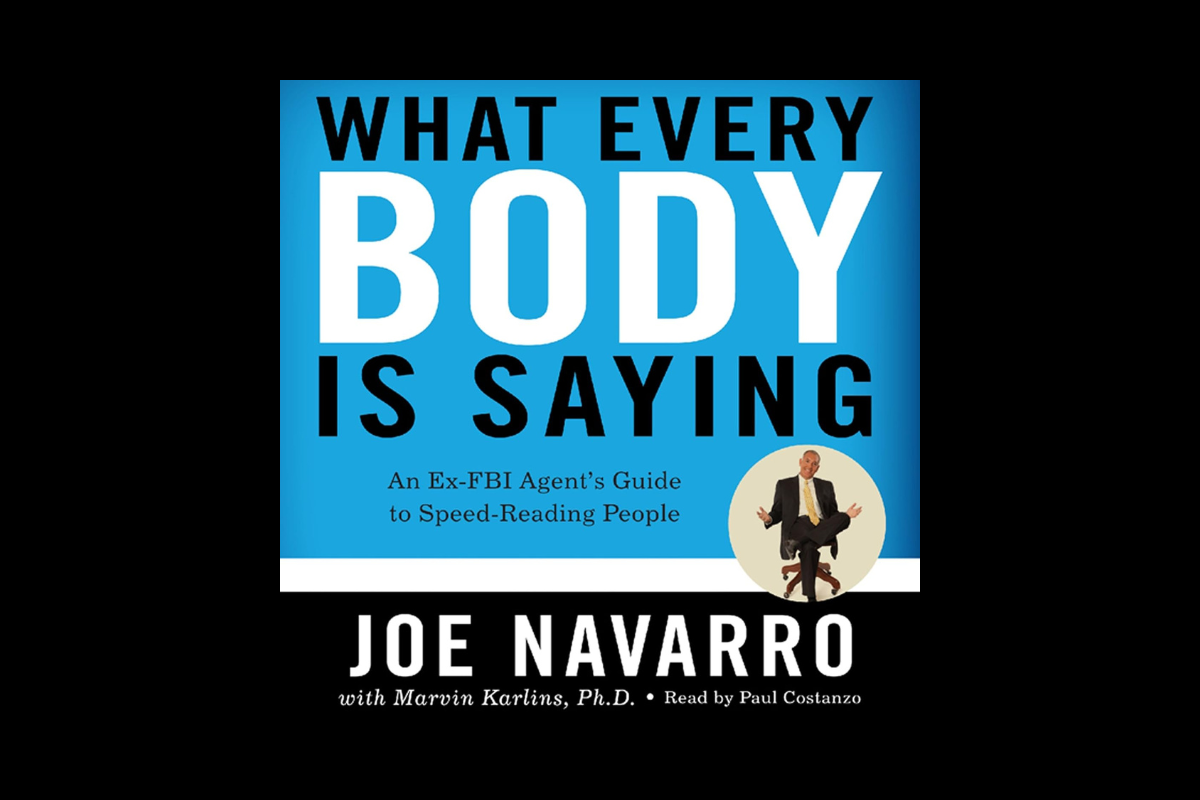
In the introduction of What Every Body is Saying, Joe Navarro is presented as a former FBI agent whose expertise in reading nonverbal behavior allowed him to identify criminals and spies by carefully observing subtle physical reactions.
A Defining Interrogation Story
The introduction opens with an interrogation in which a seemingly minor suspect is questioned about possible murder weapons. While verbally composed, the man displays a subtle but telling physical reaction when the true weapon is mentioned—information that had not been publicly released. By noticing this involuntary response, the investigator recognizes its significance and ultimately identifies the suspect as the perpetrator.
This story illustrates the book’s central premise: the body often reveals information that words attempt to conceal.
Navarro’s Expertise in Nonverbal Communication
Navarro’s professional background is highlighted to establish credibility. Over a long career with the FBI, he specialized in observing and interpreting nonverbal cues such as:
-
Facial expressions
-
Gestures and body movements (kinesics)
-
Use of space (proxemics)
-
Touch behaviors (haptics)
-
Posture and physical positioning
-
Clothing and appearance
Through careful study and practical application, he developed an ability to detect hidden emotions, intentions, and inconsistencies between words and actions.
Scientific Foundations
The introduction emphasizes that the book is grounded in scientific research rather than speculation. Advances in neuroscience—particularly in brain imaging—have clarified the role of the limbic system in producing automatic, unconscious physical responses. These instinctive reactions often occur before conscious thought can intervene, making them especially reliable indicators of genuine emotion.
By combining scientific findings with decades of field experience, Navarro provides a framework that is both research-based and tested in high-stakes environments.
A Practical Guide for Everyday Life
Although Navarro’s skills were honed in criminal investigations and intelligence work, the introduction stresses that this knowledge is useful beyond law enforcement. Readers can apply these insights in:
-
Business negotiations
-
Professional interactions
-
Personal relationships
-
Medical and caregiving contexts
The goal is not simply to “catch” deception but to better understand human behavior and improve communication.
A Caution About Detecting Deception
A notable theme in the introduction is restraint. While nonverbal behavior can provide valuable insights, the text warns against making quick judgments about honesty or dishonesty. Detecting deception is complex and requires careful interpretation rather than simplistic assumptions about body language.
What Readers Can Expect
The introduction concludes by inviting readers to develop observational skills that will help them decode human behavior more accurately. Mastery requires attention, practice, and thoughtful application, but the reward is a deeper understanding of what people communicate without speaking.
Ultimately, the introduction frames the book as a bridge between scientific insight and practical skill—teaching readers how to observe carefully and interpret what the body silently expresses.