
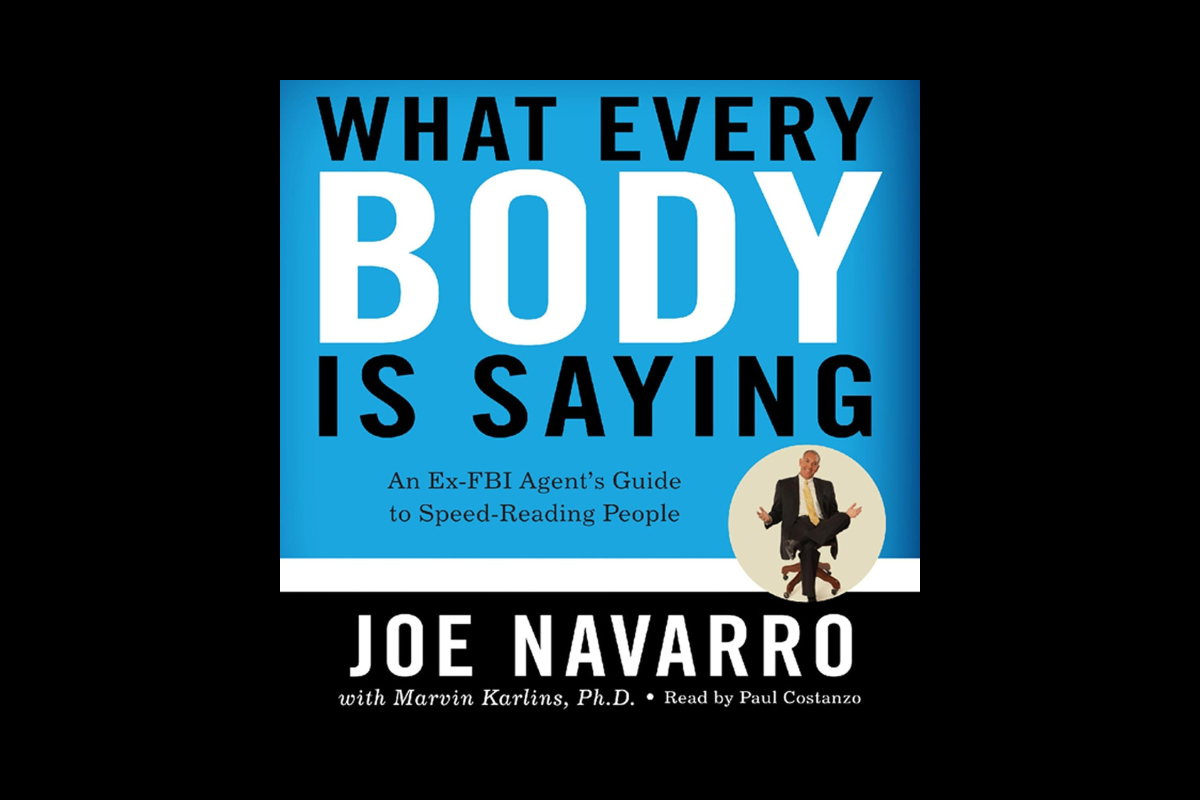
In the conclusion of What Every Body Is Saying, Joe Navarro closes by reinforcing the book’s central idea: once you learn how to “look” for nonverbal behavior, it becomes easier to notice—and far more useful than you may have expected.
The Coral Gables Lesson: Knowing Where to Look
Navarro shares a story about someone trying to find an address in an unfamiliar city. She initially struggles because she searches for signs in the usual place, only to discover the street markers are positioned much lower than expected. Once she learns the correct location and what the markers look like, navigation becomes straightforward.
He uses this as a metaphor for reading people: many of us search for meaning primarily in what others say, because that’s where we’ve been trained to look.
Two Kinds of “Signs”: Verbal and Nonverbal
Navarro frames human communication as having two channels:
-
Verbal signals: obvious, explicit, and socially emphasized.
-
Nonverbal signals: often subtle, routinely overlooked, and highly informative once you learn how to observe them.
The key takeaway is that nonverbals aren’t necessarily hidden—they’re frequently missed because our attention is aimed elsewhere.
What Changes When You Learn Nonverbals
He argues that learning nonverbal communication changes your everyday experience in a practical way:
-
You become better at noticing emotional shifts and intentions.
-
You start to interpret interactions more accurately because you’re using both “languages” at once.
-
You gain a richer understanding of relationships, conflict, comfort, and connection.
Final Message: A More Complete View of People
Navarro ends on an encouraging note: the skill of observing nonverbal behavior deepens your awareness of others and strengthens your interactions over the long term. The knowledge is meant to be applied thoughtfully, helping you navigate the “spoken and silent” parts of human behavior with more clarity and confidence.