
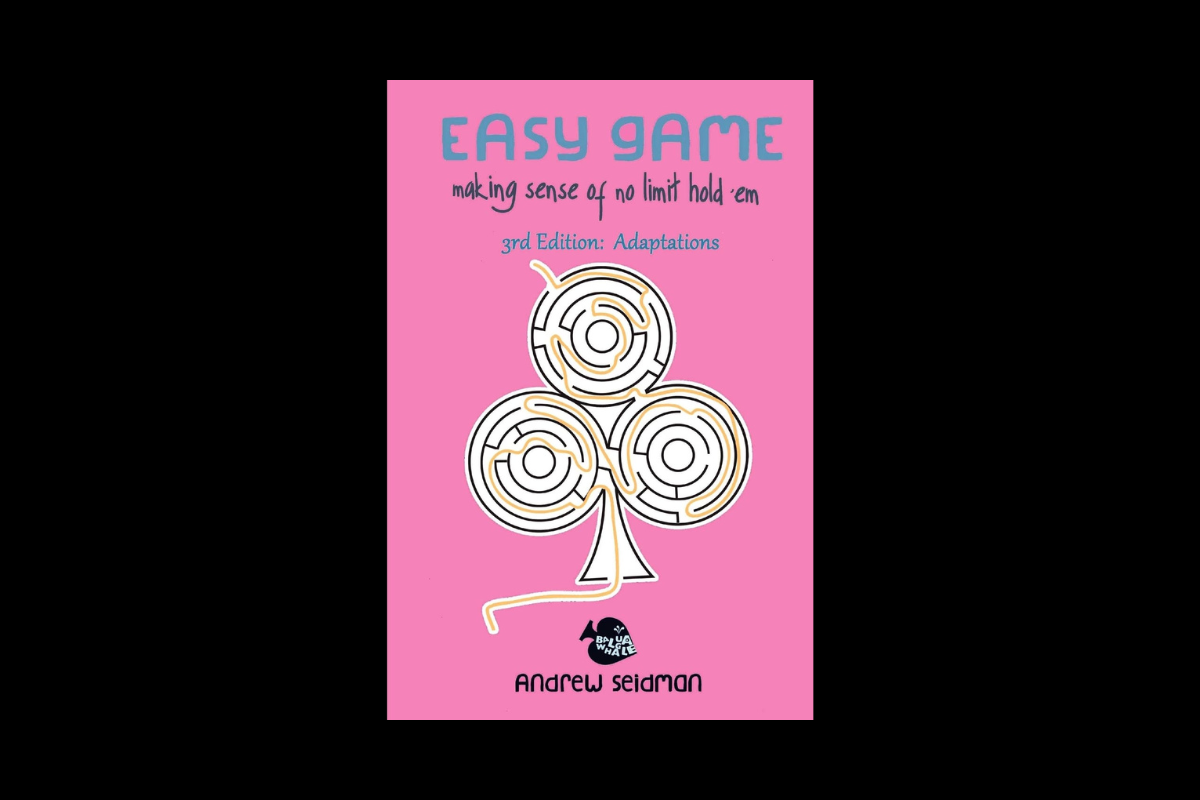
In the introduction of Easy Game, Andrew Seidman explains that the book was originally written to simplify poker strategy for both beginners and experienced players, but over time he came to see gaps in the earlier editions. Feedback from students and readers revealed important questions and concepts that had not been fully addressed. As the game evolved, so did his understanding of it.
Rather than rewriting the book entirely, Seidman chose to preserve much of the original material while adding commentary, clarifications, and new chapters. When he no longer agrees with earlier ideas, he marks and discusses them, allowing readers to trace the development of his thinking. He emphasizes that understanding this evolution is more valuable than memorizing specific conclusions, as it equips readers to anticipate future shifts in poker strategy.
A Practical, Concept-Driven Approach
Seidman makes clear that the book is not focused on heavy mathematical analysis. While poker math ranges from straightforward probability calculations to extremely complex range analysis, he argues that much of the advanced math is impractical to compute during actual play. Instead, he aims to explain complicated ideas in accessible language, prioritizing conceptual clarity over formulas.
The goal is not to avoid depth, but to present deep strategic ideas in a way that players can realistically apply at the table.
Learning from Downswings and Change
Seidman reflects on his own struggles at high stakes, including a significant losing stretch. While variance played a role, he acknowledges that some of his previously accepted strategies had become outdated. Other top players had adapted faster, maintaining an edge while he lagged behind.
This experience reshaped his perspective. He stepped away from poker for a time, focused on personal life and travel, and later returned with renewed curiosity. Coaching and collaborating with students became a key driver of new theoretical insights, and much of the updated content in this edition stems from those discussions. He portrays poker as an ongoing puzzle, with new layers of complexity constantly emerging.
The Nature of No-Limit Hold’em
Seidman highlights the appeal and danger of No-Limit Texas Hold’em, often regarded as the most dynamic form of poker. Because players can wager any amount at any time, creativity and risk are amplified. One major mistake can cost an entire stack, making disciplined decision-making essential.
He stresses that poker fundamentally revolves around minimizing mistakes. The player who makes fewer and smaller errors over time will profit. Despite the apparent simplicity of this principle, many players—strong ones included—frequently deviate from optimal decisions.
Essential Terminology
Before progressing, Seidman introduces core terminology used throughout the book. These include:
-
Flop and hand notation conventions to describe board textures and suitedness.
-
Positional terms such as under-the-gun (UTG) and cut-off.
-
Stack measurements in big blinds (bb).
-
Strategic actions like continuation betting, 3-betting, check-raising, floating, and leading.
-
Concepts such as wet and dry boards, expected value (EV), implied odds, and reverse implied odds.
-
Statistical measures like VPIP (voluntarily putting money into the pot) and PFR (preflop raise percentage).
These definitions form the shared language necessary to understand the strategic discussions that follow.
Structure of the Book
The book is divided into two major parts:
-
Foundational Knowledge – Core concepts required to become a competent and profitable player.
-
Advanced Concepts – Higher-level ideas crucial for succeeding at tougher stakes.
Seidman strongly advises readers not to skip the fundamentals. Many small-stakes players imitate advanced strategies used by high-stakes professionals without grasping the underlying framework, which often leads to losses rather than gains.
A Learning-Oriented Mindset
The introduction closes with a clear philosophical point: improvement in poker comes from prioritizing learning over immediate results. Players who obsess over short-term winning often stagnate, while those focused on understanding and growth continue to advance.
Each chapter is presented as a building block. Readers are encouraged to absorb each concept fully before moving on, approaching poker not as a shortcut to quick profits, but as a long-term intellectual pursuit.