
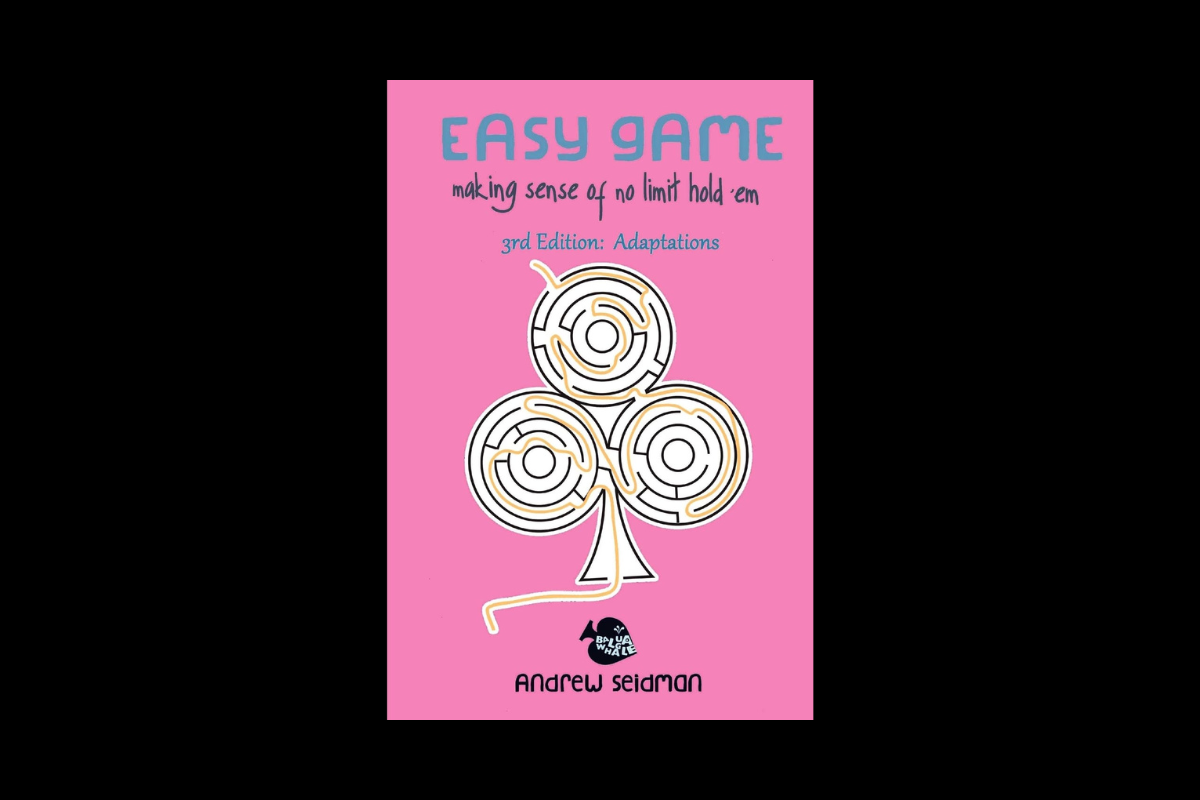
Here are chapters 11–15 of our Easy Game summary:
Chapter 11: Value Streets and Pot Management
In chapter 11, Andrew Seidman reframes “pot control” as pot management—the deliberate shaping of the pot to match how much value your hand deserves.
He distinguishes between:
-
Static Value – How many streets of value you want at a given moment (e.g., three streets with a strong hand, one with a marginal hand).
-
Dynamic Value – How that plan must change as the board and opponent ranges evolve.
A strong preflop hand may become a hand that wants no further value on a dangerous flop. Good players adjust immediately when new information—especially raises—narrows an opponent’s range toward strength.
Seidman stresses forward planning. If the goal is to stack an opponent, early bets must build a pot that allows a natural river shove. Betting too small early often prevents full value later or forces awkward overbets.
Pot management also applies defensively. The constant question is:
How much value does my hand deserve now—and how might that change?
The core idea is intentional sizing across streets to maximize profit and avoid overcommitment.
Chapter 12: Basic Street Projection
In chapter 12, Andrew Seidman introduces street projection—thinking ahead to determine whether acting now or later produces greater value.
Even if a bet is profitable, it may not be optimal. Against aggressive opponents, checking a strong hand can induce bluffs or allow for a check-raise that extracts more than a direct lead. Against passive opponents, immediate betting may be necessary to avoid missed value.
Street projection also applies to bluffing. If an opponent will fold weak hands on any street, delaying aggression can:
-
Provide more information.
-
Increase fold equity on later streets.
-
Save money when strength is shown.
As hands progress, players often feel more pressure. River bluffs can therefore succeed more frequently than earlier attempts.
The guiding question is:
Is this the best street to act, or will waiting improve the outcome?
Street projection turns isolated decisions into forward-looking plans.
Chapter 13: Showdown Theory
In chapter 13, Andrew Seidman focuses on showdown value—the likelihood your hand wins if no more betting occurs.
Betting reshapes the opponent’s range. If worse hands will not call and better hands will not fold, betting often isolates you against stronger holdings. Checking preserves weaker hands in their range and protects your equity.
Checking behind is generally correct when:
-
Worse hands are unlikely to call.
-
The board is safe and unlikely to change dramatically.
Betting is correct when:
-
Worse hands will continue.
-
Your hand is vulnerable to being outdrawn.
The key concept is range manipulation—ensuring your action keeps the opponent’s range favorable relative to your hand.
The central question becomes:
Does betting improve or reduce my hand’s value against their range?
Chapter 14: Monotone Boards and Equity
In chapter 14, Andrew Seidman analyzes monotone flops (three cards of the same suit), where equity is widely distributed.
On these boards:
-
Many hands have strong draws plus pairs.
-
Raises typically represent extreme strength.
-
Bluffing is less attractive due to widespread equity.
A major mistake is underestimating draw equity. Even when ahead, you may be only slightly ahead. When behind to a made flush, you are often far behind. In “slightly-ahead or way-behind” scenarios, stacking off requires the slightly-ahead portion to dominate overwhelmingly.
Because raises rarely come light, disciplined folds with one-pair hands are often correct.
The takeaway: monotone boards demand caution, equity awareness, and avoidance of thin stack-offs.
Chapter 15: A Brief (Mis)Understanding of G-Bucks
In chapter 15, Andrew Seidman explains the concept of G-Bucks, originally introduced by Phil Galfond. Profitability should be evaluated against an opponent’s range, not their specific hand.
Being ahead more than half the time does not guarantee profit. What matters is total equity against the entire weighted range. A range containing both strong made hands and powerful draws can still dominate you overall—even if you are technically ahead frequently.
Seidman notes that precise range calculations are often impractical at the table. Instead, players should develop strong intuition about how their hand performs against likely ranges.
The core principle:
Judge decisions by how they perform against ranges, not by single-hand outcomes.
This perspective prevents results-oriented thinking and reinforces disciplined, long-term evaluation.